The Acropolis is probably the most recognisable building on earth, and one of the easiest to walk through without understanding a thing. Most visitors climb the hill, photograph the Parthenon, register that it is very old and very impressive, and head back down none the wiser about what they just saw. Which is a shame, because the Acropolis is not really one temple. It is a sacred citadel, and read properly it is one of the places where the Western idea of architecture, beauty, and civic life was worked out in stone.
So this is what you are actually looking at up there, why it still matters, and how to see it well rather than just see it. The how matters more than it used to, because the ticketing changed, the crowds are heavy, and the summer heat on that exposed rock is no joke.
What you’re actually looking at
The hill itself is a limestone plateau about 156 metres above the city, fortified by nature long before anyone built on it. What crowns it now is mostly the work of a single extraordinary building programme in the 5th century BC, under the Athenian leader Pericles, paid for in part with the treasury of Athens’ allies, which was controversial even at the time.
The Parthenon is the one everyone knows. Built between 447 and 432 BC and dedicated to Athena, the goddess who gave the city its name, it was designed by the architects Iktinos and Kallikrates, with the sculptor Phidias overseeing the decoration. Inside once stood a colossal statue of Athena in gold and ivory, around twelve metres tall, long since lost. The building is full of quiet visual tricks: the columns lean slightly inward and swell in the middle, and lines that look straight actually curve, all so the temple reads as perfectly proportioned to the human eye. It is engineering disguised as serenity.
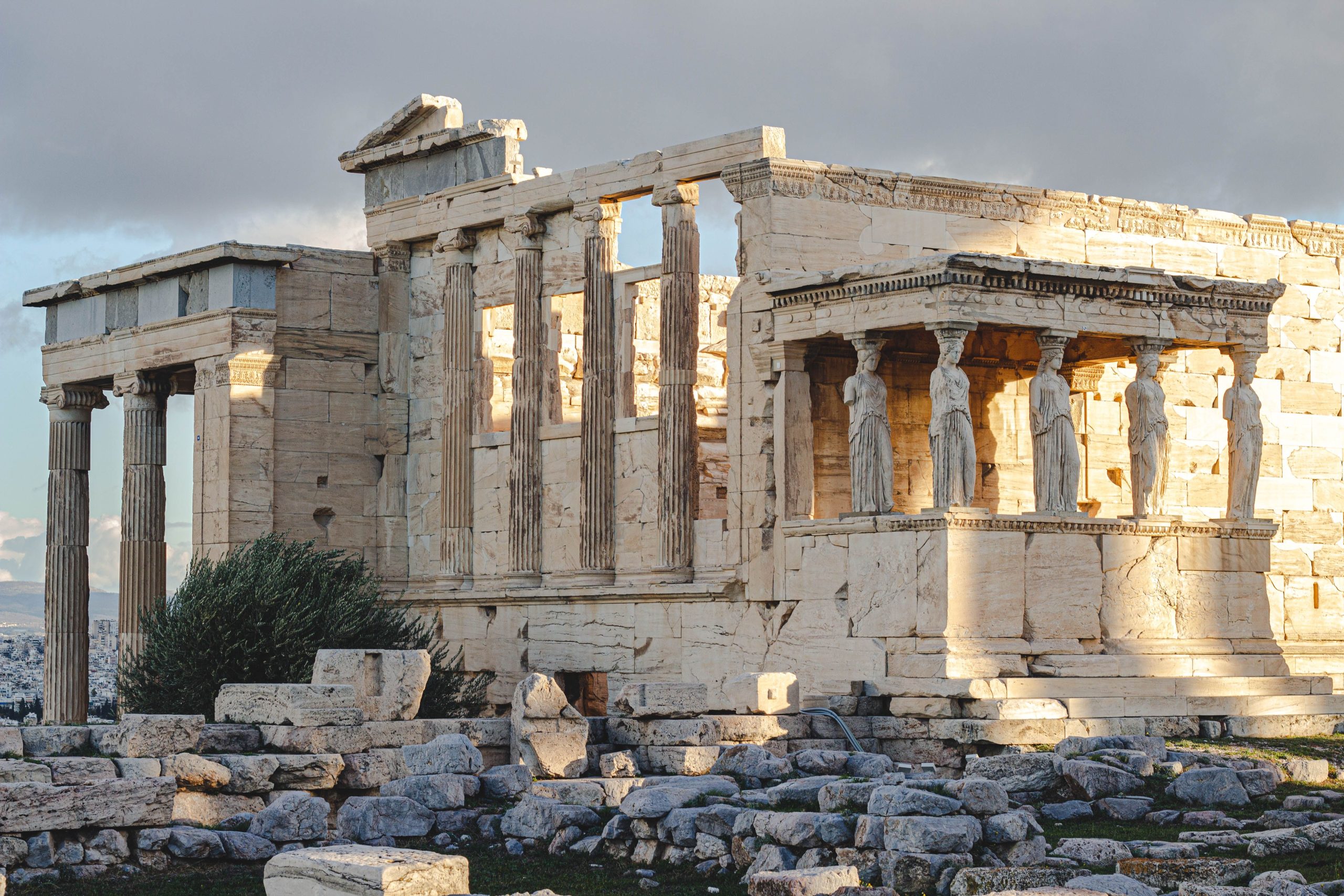
It is not the only thing up there. The Erechtheion, off to the side, carries the Caryatids, a porch held up by six sculpted women in place of columns, and it is the more sacred of the two buildings, sitting on the oldest cults of the city. The Propylaea is the monumental gateway you pass through on the way in, and the small Temple of Athena Nike perches on a bastion to the right of it. Down on the south slope, below the rock, are two theatres: the Theatre of Dionysus, where Greek drama was effectively born and the plays of Sophocles and Euripides were first staged, and the Odeon of Herodes Atticus, a Roman amphitheatre still in use today for summer performances.
Why it looks the way it does
The Parthenon’s ruined state is not just the slow work of time. For most of its life it was not a ruin at all. It served as a church, then a mosque, and survived more or less intact for over two thousand years.
What broke it was a single afternoon in 1687. The Ottomans, then holding Athens, were using the Parthenon as a gunpowder store during a war with Venice. A Venetian shell found it, and the resulting explosion blew the middle out of the building. Much of what you now see missing dates from that one blast and the looting that followed.
The other absence is more deliberate and more contested. In the early 1800s a large portion of the Parthenon’s sculptures was removed by Lord Elgin and shipped to Britain, where they remain in the British Museum. Greece has been asking for them back for decades, and the argument is still live. It is worth knowing about before you go, because it changes how you read both the building and the museum at its foot.
Why a guide is worth it here
You can absolutely walk the Acropolis on your own, and plenty of people do it with a phone audio guide, which is a reasonable budget option. But this is one of the genuine cases where an expert changes the experience rather than just narrating it.
The reason is that the site does not explain itself. Much of what stands has been reconstructed over the last century, so without context it is hard to tell what is ancient and what was put back, and the scaffolding that has been a near-permanent feature of the Parthenon confuses people further. A good guide ties the architecture to the mythology, to the politics of Periclean Athens, and to the long afterlife of the place, and turns a field of marble into a story you can follow. Operators like Context Travel run small-group and private Acropolis tours led by archaeologists and classical historians rather than script-readers, usually paired with the museum, which is the format that gets the most out of a first visit. If you are only going to do this once, doing it with someone who can read the stones for you is the difference between seeing it and understanding it.
Don’t skip the museum
The single most common mistake people make is treating the Acropolis Museum as optional. It is not. It is the other half of the visit.
Sitting at the foot of the south slope, a few minutes’ walk from the rock, the Acropolis Museum holds the original sculptures that have been taken off the monuments for protection, including the real Caryatids, with replicas now standing in their place on the Erechtheion. The top floor is the masterstroke: a glass hall built to the exact dimensions and orientation of the Parthenon, so the frieze is displayed as it once sat on the building, with the actual Parthenon visible through the windows. The gaps in that gallery, where the sculptures held in London would go, are left deliberately empty, which is the museum making its argument without saying a word. Visit it after the rock, while the layout is fresh in your mind, and the whole site clicks into place.
Tickets, timing, and the practical reality
This is where preparation pays off. The Acropolis now runs on mandatory timed entry. When you book you choose a one-hour slot, and the ticket is only valid in that window, with about fifteen minutes’ grace on either side. A standard adult ticket is 30 euros, a flat rate year-round since prices changed in 2025, and EU citizens under 25 enter free with ID. Book on the official platform, hhticket.gr, run by the Greek Ministry of Culture, which sells at the real price with no markup.
A few things worth knowing. There is a daily cap of around 20,000 visitors, and in peak summer the slots sell out five to seven days ahead, so this is not a walk-up attraction in July. Tickets are issued in your name and ID is checked at the gate. And ignore the “skip the line” language you will see on resale sites: the timed-entry system is the queue, everyone passes through the same security, and there is no genuine fast pass.
On timing, go early or late. The 8am slot, right at opening, gives you the coolest air, the thinnest crowds, and the morning light on the marble. The last couple of hours before closing are the second-best window, when the cruise crowds have gone and the stone turns gold. Avoid the middle of the day in summer, when the exposed rock can hit 35 to 40 degrees, the tour groups peak, and the site has occasionally closed at midday during the worst heatwaves.
Two last practical notes. Wear shoes with grip, because decades of footfall have polished the marble and the bare rock to something genuinely slippery, and people turn ankles up there every day. And do not climb on or touch the monuments, which is firmly enforced, with fines and ejections for anyone who tries.
The short version
The Acropolis is one of the few sights that genuinely rewards understanding over speed. Book a timed slot well ahead on the official site, go at opening or near closing to dodge the heat and the crowds, pair the rock with the museum below it, and get someone who knows the history to walk you through it. Do that, and the field of weathered marble resolves into what it actually is: the high point, in every sense, of the ancient Greek world.