Florence has a density problem, and it is the visitor who pays for it. No city on earth packs more masterpieces into fewer square meters, which sounds like a gift until you are standing in the Uffizi on a July afternoon, ninety minutes into a shuffle past two thousand works, unable to remember why any of it matters. People leave the greatest museum in Italy exhausted rather than moved, and it is almost always a planning failure rather than a failure of interest.
The fix is understanding what the Uffizi actually is, knowing the handful of rooms where the story turns, and getting the ticketing right, which changed again this year. Here is all three.
What the Uffizi actually is
The building came first and explains the name. Giorgio Vasari raised it in 1560 as the administrative offices of the Medici, the banking family that ran Florence, and “uffizi” means exactly what it sounds like: offices. The family used the upper floor to hang its private collection, and when the last Medici heir died she left the whole of it to the city on the condition that it never leave Florence. The world’s first great modern museum is, in essence, the world’s grandest converted office block.
The genius of the place is the hang. The collection runs in rough chronological order, which means walking the Uffizi is walking through the single most important shift in the history of images. You start among the gold-ground Madonnas of Giotto and Cimabue, flat and floating and pointing at heaven, and room by room you watch depth, weight, and human feeling get invented, until the figures stand in real space and look back at you. No other museum lets you watch the Renaissance happen in sequence like this, and once you know that is the plot, the corridors stop being a slog and become a story.
The rooms where the story turns
A focused visit needs only a handful of fixed points, and they come in order.
The Botticelli rooms are the heart of the museum, holding the Birth of Venus and the Primavera, the two most famous paintings in Florence and the moment the pagan world walks back into European art. Go to these rooms first, right at opening, before the tour groups form their semicircles.
Then Leonardo: the Annunciation, painted while he was still barely more than a student, and the unfinished Adoration of the Magi, which is the rare chance to see how he built a picture. Nearby hangs the Doni Tondo, the only finished panel painting by Michelangelo, whose twisting figures and acid colors are effectively the Sistine ceiling in rehearsal. Further on, Titian’s Venus of Urbino shows what Venice did with everything Florence invented, and Caravaggio’s snarling Medusa, painted on an actual parade shield, closes the story with the Renaissance curdling into something darker.
Two quieter pleasures reward the unhurried. The long corridors are lined with more than two hundred ancient Roman busts that most visitors stride past, and the octagonal Tribune, with its mother-of-pearl dome, was purpose-built by the Medici as a jewel box for their most precious things. And when fatigue hits, the terrace café sits above the Loggia with one of the best close-up views of the Palazzo Vecchio’s tower in the city.
The corridor over the river
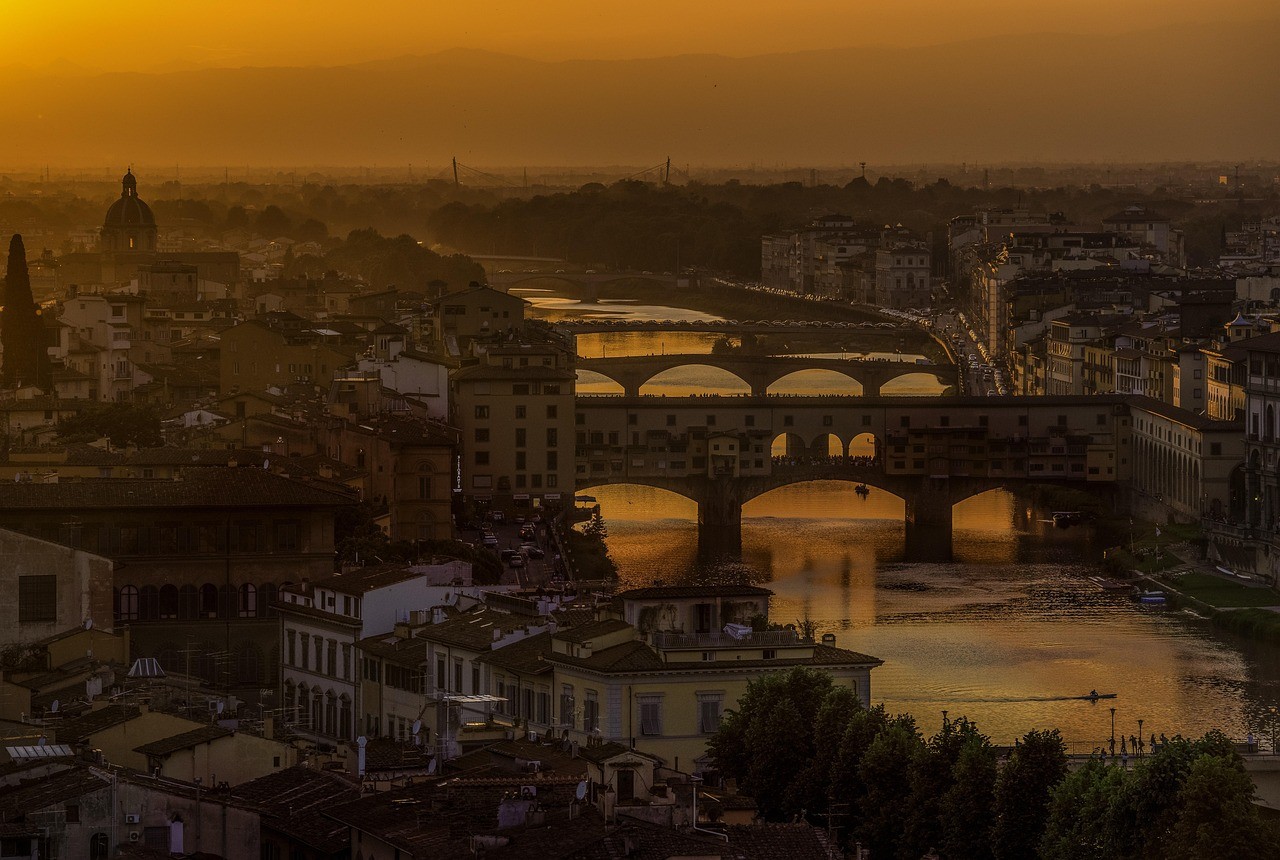
One more thing sits inside the Uffizi that for decades almost nobody could enter. The Vasari Corridor is the elevated passage the Medici built so they could walk from their offices, over the Ponte Vecchio, to their palace on the other side of the Arno without touching a public street. After years of closure it is open again, and it works as a one-way walk from the Uffizi across the river to the Pitti Palace, on a combined ticket with a timed slot, entering the museum a couple of hours before your corridor time. In summer 2026 it even runs evening openings into the night. Walking a private passageway above the bridge while the crowds churn below is as close as Florence gets to time travel, and slots are scarce, so book it early if it tempts you.
The dome that started it all
The Uffizi explains where painting went. The cathedral square explains where the whole era’s confidence came from. Brunelleschi’s dome, raised over the Duomo in the early 1400s without scaffolding that anyone believed could work, was the engineering shock that told Florence anything was possible, and it is still the largest masonry dome ever built. Facing it stand Giotto’s bell tower and the Baptistery with Ghiberti’s gilded bronze doors, the ones Michelangelo supposedly called the Gates of Paradise.
The practical shape of a visit: entering the cathedral itself is free, but the queue is long and the interior surprisingly plain, because the treasures have moved to the museum. Everything worth climbing or entering runs on the Brunelleschi Pass from the official Opera del Duomo site, which covers the dome climb, the bell tower, the Baptistery, the crypt, and the excellent museum across three days, with the dome climb itself on a booked time slot that sells out well ahead in season. The climb is 463 steps with no elevator, squeezing between the dome’s two shells, and the view from the lantern is the best thing in Florence that costs effort.
Why a guide earns the fee here
The Uffizi is the strongest case in Italy for seeing a museum with an expert, for a simple reason: the revolution is invisible without context. The labels tell you names and dates. They do not tell you why a Giotto Madonna was a thunderclap, what the Medici were buying when they paid for a Botticelli, or why the Doni Tondo’s colors looked insane to contemporaries, and that is the actual content of the museum. A good art historian walks you through the turn of the story in two hours and leaves you seeing differently, which is the point of Florence. Operators like Walks of Italy run small-group Uffizi tours led by art historians rather than script-readers, with reserved entry so the queue is not part of the experience, and versions that fold in the Accademia and the city’s landmarks for a first visit. If you are only going to walk these rooms once, walk them with someone who can read them.
Tickets, timing, and the practical reality
The mechanics decide the mood of the day, so get them right.
Book on the official Uffizi site, where tickets are named, timed, and reservation-only in practice for high season, with the year’s dates released in waves from early February. The museum is closed on Mondays, a detail that quietly wrecks a surprising number of one-day itineraries, and closed on Christmas Day and New Year’s Day. Two money-savers are worth knowing. New from 2026, entry after 4pm costs 16 euros, and with the museum open until 6:30 that is enough time for the focused version of the visit at a fraction of the peak price. And the first Sunday of each month is free, which sounds like a gift and delivers the worst crowds of the month, so treat free Sunday as a day to be elsewhere.
On rhythm: arrive for the 8:15 opening on a midweek morning and walk straight to the Botticelli rooms while they are quiet, or come after 4pm when the groups have gone. Give the museum two focused hours rather than four dutiful ones. Book the Accademia separately if David is on the list, since its timed slots sell out too. And if the choice exists, come in autumn, when the summer crush thins, the light turns gold on the Arno, and Florence goes back to being a city rather than a queue.
The short version
Treat Florence as a story rather than a checklist. Learn the one plot the Uffizi tells, walk it at opening or after four with the handful of turning-point rooms as your fixed marks, book the corridor or the dome climb early if they call to you, and put the mechanics, the Monday closure, the named tickets, the free-Sunday trap, into the plan before you arrive. The city that taught Europe how to see rewards nothing so much as being looked at properly.