Anyone who visited Cairo before 2021 and returns this winter will find the city’s antiquities in different buildings, in some cases several kilometres apart. The gold mask has moved. The royal mummies have moved. Khufu’s boat has moved. Even the gate you walk through to reach the pyramids is not the one that appears in older guidebooks.
None of this happened by accident. Egypt spent three decades planning a redistribution of its own collection, and the last five years executing it. The result is that the country now has three separate museums in Cairo telling three different stories, plus an archaeological site that has been reorganised around them. Knowing which building holds what is the difference between a satisfying week and a lot of taxi rides.
The century that everything sat in one room
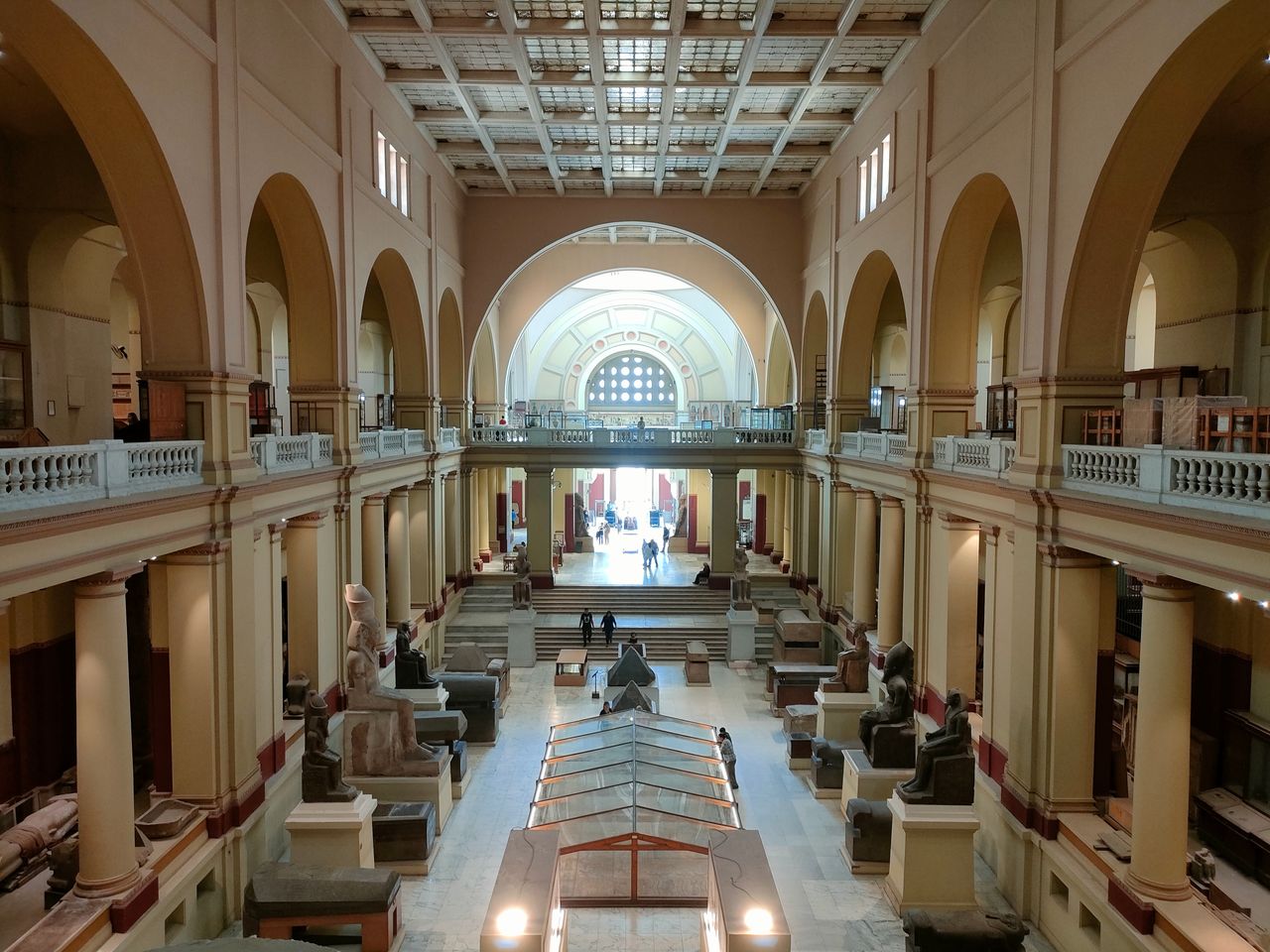
For most of the twentieth century the answer was simple. The Egyptian Museum on Tahrir Square, opened in 1902 in a salmon-pink neoclassical building designed by the French architect Marcel Dourgnon, held essentially everything. Howard Carter’s finds from the Valley of the Kings arrived there after 1922 and stayed. So did the mummies of the pharaohs, displayed in what was, by the standards of modern museum design, an ordinary room.
The building was magnificent and completely overwhelmed. Its cases held objects stacked in the way collections were arranged before anyone thought about visitor flow, and a great deal of the Tutankhamun material never came out of storage at all. More than half of the objects Carter catalogued had never been publicly exhibited anywhere.
The Grand Egyptian Museum, and what is actually in it
The Grand Egyptian Museum was first proposed in the 1990s. Its opening ceremony finally took place on 1 November 2025, with the galleries open to the public days later. The complex sits on the Cairo to Fayoum road within sight of the pyramids, cost more than $1.2 billion, covers over 500,000 square metres and holds around 100,000 objects spanning seven millennia.
The building is worth looking at before going inside. The Irish practice Heneghan Peng designed it as a chamfered triangle in sand-coloured concrete and translucent alabaster, with its north and south walls aligned to the pyramids of Khufu and Menkaure. Egyptians have taken to calling it the fourth pyramid, which sounds like marketing and turns out to be a fair description of how it reads from the plateau.
Inside, the Grand Staircase climbs past dozens of royal statues toward a window that frames the pyramids. The colossal statue of Ramses II, eleven metres of granite that spent decades in a traffic-choked square by Cairo’s main railway station, stands in the atrium. A suspended obelisk of the same pharaoh lets visitors walk beneath it and look up at the base, which no ancient Egyptian could have done. Khufu’s cedar funerary boat, roughly 4,600 years old and one of the oldest intact vessels anywhere, was moved here from its old purpose-built hall on the plateau.
Then there are the Tutankhamun galleries, 7,500 square metres holding all 5,398 objects from the tomb together for the first time since Carter emptied it. The German studio Atelier Brückner arranged the space so that two narratives unfold depending on which way you walk, one following the king’s life and reign, the other following the discovery of the tomb. The gold mask sits near the entrance behind glass 40 millimetres thick. Artnet published a guide to the pieces going on public display for the first time, which is a useful thing to skim beforehand, because the famous objects pull attention away from the ones nobody has seen.
One practical point that catches people out. Since December 2025 the museum sells no tickets at the door. Entry is by timed slot booked in advance, and Egypt’s State Information Service has named visit-gem.com as the only authorised platform after a fake ticketing site was shut down. Foreign adult admission has been running at roughly EGP 1,450, somewhere near $30, with much lower rates for Egyptian nationals and reduced rates for students and children. The Ministry revises those figures periodically, so treat any number in an article as a guide rather than a quote.
The mummies are somewhere else entirely
This is the mistake that costs visitors a morning. The royal mummies are not at the Grand Egyptian Museum and never were.
On 3 April 2021, twenty-two mummies, eighteen kings and four queens, travelled across Cairo in nitrogen-filled capsules on decorated vehicles in a televised procession billed as the Pharaohs’ Golden Parade. Their destination was the National Museum of Egyptian Civilization in Fustat, in Old Cairo, where they are now displayed in a purpose-built hall designed to feel like walking through the Valley of the Kings: low light, minimal signage, and a deliberate quiet. Ramses II, Seti I, Hatshepsut and Thutmose III are all there.
Tutankhamun is not. His mummy never left Luxor, and still lies in tomb KV62 in the Valley of the Kings, which is a strange thing to think about while standing in front of his mask in Giza.
The museum around the hall tells a longer story than the pharaonic one, running through Coptic and Islamic Egypt as well, and it sits close enough to Coptic Cairo that the two make a natural half day together.
What is left at Tahrir, and why it still matters
With the Tutankhamun collection gone to Giza and the mummies gone to Fustat, some Egyptians worried the old museum had been hollowed out. It has not. Tahrir still holds a collection in the region of 170,000 objects, including the Narmer Palette, which records the unification of Upper and Lower Egypt more than five thousand years ago and is arguably the single most historically loaded item in the country. The gold from the royal tombs at Tanis is there, as are the Old Kingdom masterpieces and the funerary goods of Yuya and Thuya, Tutankhamun’s great-grandparents.
Admission runs around EGP 550, roughly $11, and the crowds have thinned considerably. The museum is being rethought around thematic displays rather than the old crush. For anyone who cares about how museums themselves evolve, the contrast between a 1902 building and a 2025 one holding the same civilisation is the most interesting hour in Cairo.
The plateau works differently now
The pyramids themselves have been reorganised under a redevelopment run by Orascom Pyramids Entertainment with the Ministry of Tourism and Antiquities. The old entrance near the Mena House hotel is no longer the main gate. Visitors now enter through a new visitor centre on the Cairo to Fayoum road, private cars and tour buses are barred from the plateau itself, and movement inside is by free electric shuttle looping between the visitor centre, the Panorama viewpoint, Menkaure, Khafre and the Sphinx.
The transition was not smooth. Horse and camel operators blocked the new access road in protest at being relocated in 2025, and early visitors complained about waiting for buses. It has settled since. The travel blog Anywhere We Roam returned in early 2026 and described the difference in detail, including the shuttle routes and roughly how long the circuit takes.
Two things to note. The Sphinx gate on the east side still works but has no ticket office, so it only helps if the ticket is already bought. And the old Solar Boat Museum on the plateau has closed, since the boat is now indoors at the Grand Egyptian Museum.
Give it more days than seems necessary
The Giza sites sit close together on a map and are exhausting in practice. The museum alone deserves three to four hours, and the distances between its galleries are real. Trying to add the plateau and a downtown museum to the same day produces the specific kind of fatigue where nothing registers after lunch. Anyone who has attempted the National Mall in a single day will recognise the pattern: free or nearby does not mean quick, and museum stamina runs out long before the opening hours do.
It is also worth remembering how much of the story lies outside Giza. The UNESCO listing that covers this area is Memphis and its Necropolis, the Pyramid Fields from Giza to Dahshur, inscribed in 1979, and it runs roughly thirty kilometres along the west bank. Saqqara holds the Step Pyramid of Djoser, the oldest of them all. Dahshur holds Sneferu’s Bent Pyramid and Red Pyramid, where the geometry was worked out by trial and error a generation before Khufu’s builders got it right.
Most visitors give Cairo two days and see the mask, the Sphinx and very little else. The city has spent thirty years and more than a billion dollars making that a poor use of the trip.