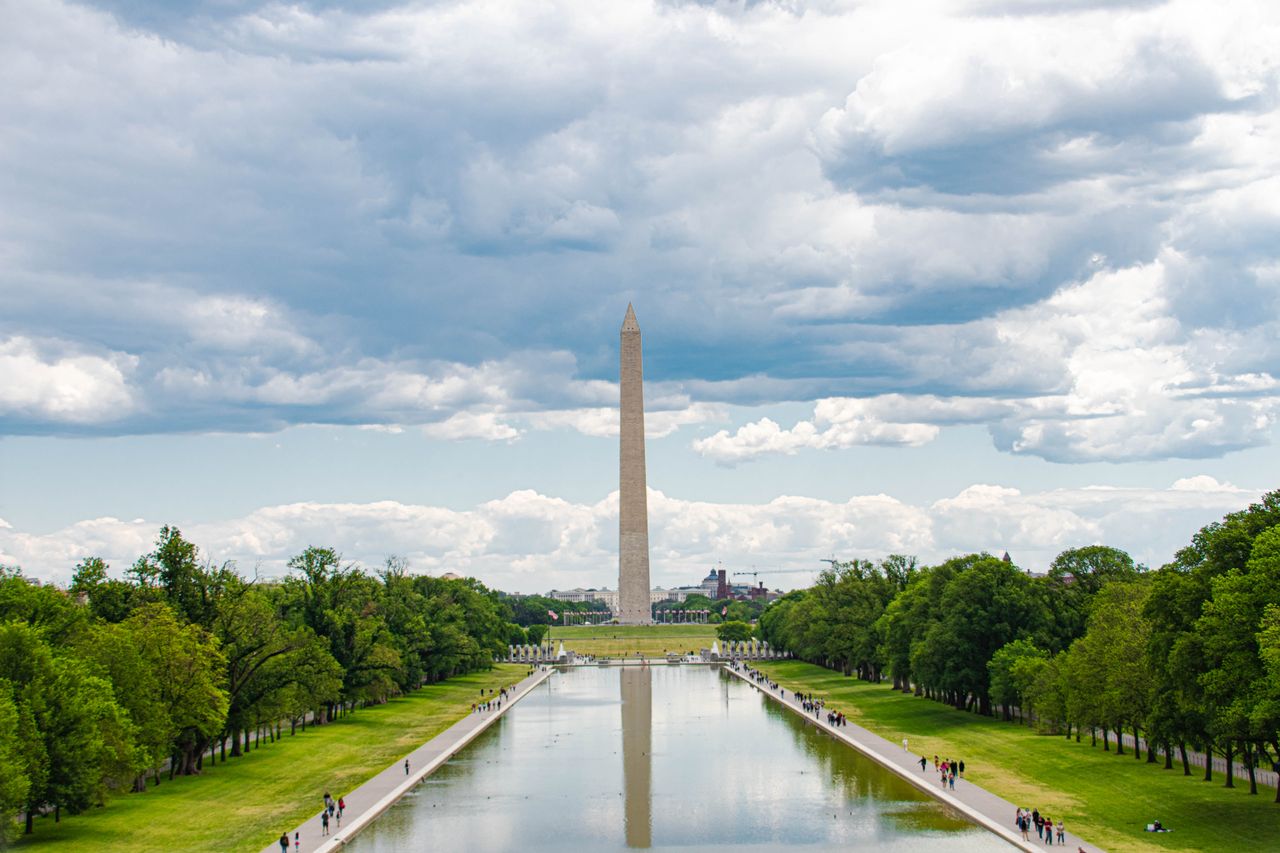
The National Mall is one of the great walkable history lessons anywhere, and one of the most commonly mishandled. People arrive, try to march the whole thing end to end in the July heat, run out of legs and patience halfway, and leave having photographed a lot of marble without much sense of what any of it means. It does not have to go that way.
This is what is actually on the Mall, why it matters, and how to see it without wrecking your feet or your afternoon. It is worth getting right this year in particular, because the country is marking its 250th anniversary, the capital is busier than usual, and parts of the Mall are being spruced up for the occasion.
The lay of the land
Washington was a planned city from the start, laid out by Pierre L’Enfant in the 1790s as a deliberate stage for a new republic, and the Mall is the centre of that design. The core runs in a straight line from the United States Capitol at the east end to the Lincoln Memorial at the west, a stretch of about two miles. The catch is that the most famous memorials are not all on that line. Several sit around the Tidal Basin to the south, so seeing everything on foot is closer to a five-mile loop, and a realistic half-day once you stop to actually look.
It helps to think of the Mall as two different things sharing one lawn. Along the sides are the museums. Out toward the west and around the water are the monuments and memorials. They reward completely different kinds of attention, and trying to do both at a sprint is how people burn out.
The memorials, and what they are arguing
The memorials are not just tributes. Each one is a statement about how the nation wants to see itself, and read in that light they get far more interesting.
The Lincoln Memorial is the anchor, a Greek temple to a president who held the country together, with the Gettysburg Address and his second inaugural carved into the side walls. Look down at the steps and you will find the spot marked where Martin Luther King Jr. delivered the “I Have a Dream” speech in 1963, with the Reflecting Pool stretching out toward the Washington Monument in front of him. The geography is doing deliberate work.
Nearby, the Vietnam Veterans Memorial is the one that rewards knowing the backstory. Maya Lin’s black granite wall, sunk into the earth and inscribed with the names of the dead, was bitterly controversial when it was chosen, and the more conventional Three Soldiers statue was added later as a concession to people who found the wall too stark. Standing between the two, you are looking at an argument about how to remember a war. The Korean War memorial, with its column of stainless-steel soldiers advancing through the landscape, makes a different choice again. The FDR memorial unfolds as a series of outdoor rooms, one for each term. The Jefferson and the towering Washington Monument hold down the classical end of the spectrum, and the newer Martin Luther King Jr. Memorial brings the story up toward the present.
A practical gift here: most of these are run by the National Park Service, free, and open around the clock, with no reservation needed. They are also genuinely beautiful after dark, lit against the sky with a fraction of the daytime crowds, which is the single best tip for seeing them well.
The museums, and the remarkable fact about them
The other half of the Mall is the museums, and the remarkable thing about them is the price, which is nothing. The Smithsonian Institution runs 21 museums and the national zoo, eleven of them lined up along the Mall, and entry to all of them is free. So is the National Gallery of Art, which sits on the Mall but is a separate institution.
That covers an enormous spread: aviation and spaceflight at the Air and Space Museum, dinosaurs and the Hope Diamond at Natural History, the national story at the Museum of American History, and the powerful, much-visited National Museum of African American History and Culture. The official Smithsonian site lists current hours and which buildings are open, which is worth a look before you go, since some galleries close for renovation on rotation.
The honest advice is to not try to do them all. Pick one or two that genuinely interest you and give them real time. The Smithsonian is designed so that a determined visitor could spend a week and not finish, and treating it as a box-ticking sprint is the fastest way to enjoy none of it.
Why the context is worth it
You can walk the Mall perfectly well on your own. The Park Service rangers stationed at the memorials are free, knowledgeable, and happy to answer questions, and the official National Park Service site covers hours, closures, and the practical basics.
But this is a place where the meaning is mostly invisible, and a bit of guidance changes how much you take away. The design decisions, the political fights behind them, L’Enfant’s original plan and how the city grew away from it, why one memorial is a marble temple and the next is a sunken wall of names, all of that is the actual substance of the Mall, and almost none of it is written on the monuments themselves. A guided history and architecture walk pulls the threads together. Operators like DC Design Tours run small-group walks that read the National Mall through its design and the stories behind how it was built, which turns a row of landmarks into a coherent argument about the country. If you only have a day in DC and want it to land, that context is what does it.
The practical reality
A few things make or break a day on the Mall.
It is a long walk. The full loop taking in the Tidal Basin memorials is around five miles, so wear real shoes and plan for roughly four hours if you are stopping to look. Washington summers are hot and seriously humid, so do the outdoor memorials early in the morning or in the evening, and save the air-conditioned museums for the worst of the midday heat. Better yet, see the memorials lit up at night.
Use the Metro and do not try to drive, since parking around the Mall is scarce and the public transport is good. The Smithsonian, Federal Triangle, and L’Enfant Plaza stations all put you right on the Mall.
A handful of sights need free tickets booked in advance, and these go quickly in summer. Going up the Washington Monument requires a timed ticket, released online ahead of time with a small fee, plus a small batch handed out same-day if you arrive early. Touring the inside of the Capitol is free but needs a reservation through the official Capitol visitor site. And while the Smithsonian museums are free, a couple, including the Air and Space Museum, now use free timed-entry passes to manage crowds, so check before you turn up. In an anniversary year with extra visitors and some ongoing construction on the Mall, booking the ticketed things ahead is more important than usual.
The short version
The Mall is best understood as the nation’s long argument with itself, told in stone and steel and a great deal of free art. See the memorials early or after dark to beat the heat and the crowds, pick one or two museums rather than chasing all of them, book the few ticketed sights ahead, and get some context for what you are looking at. Do that, and a tiring slog past famous landmarks becomes the clearest day of American history you can get anywhere.