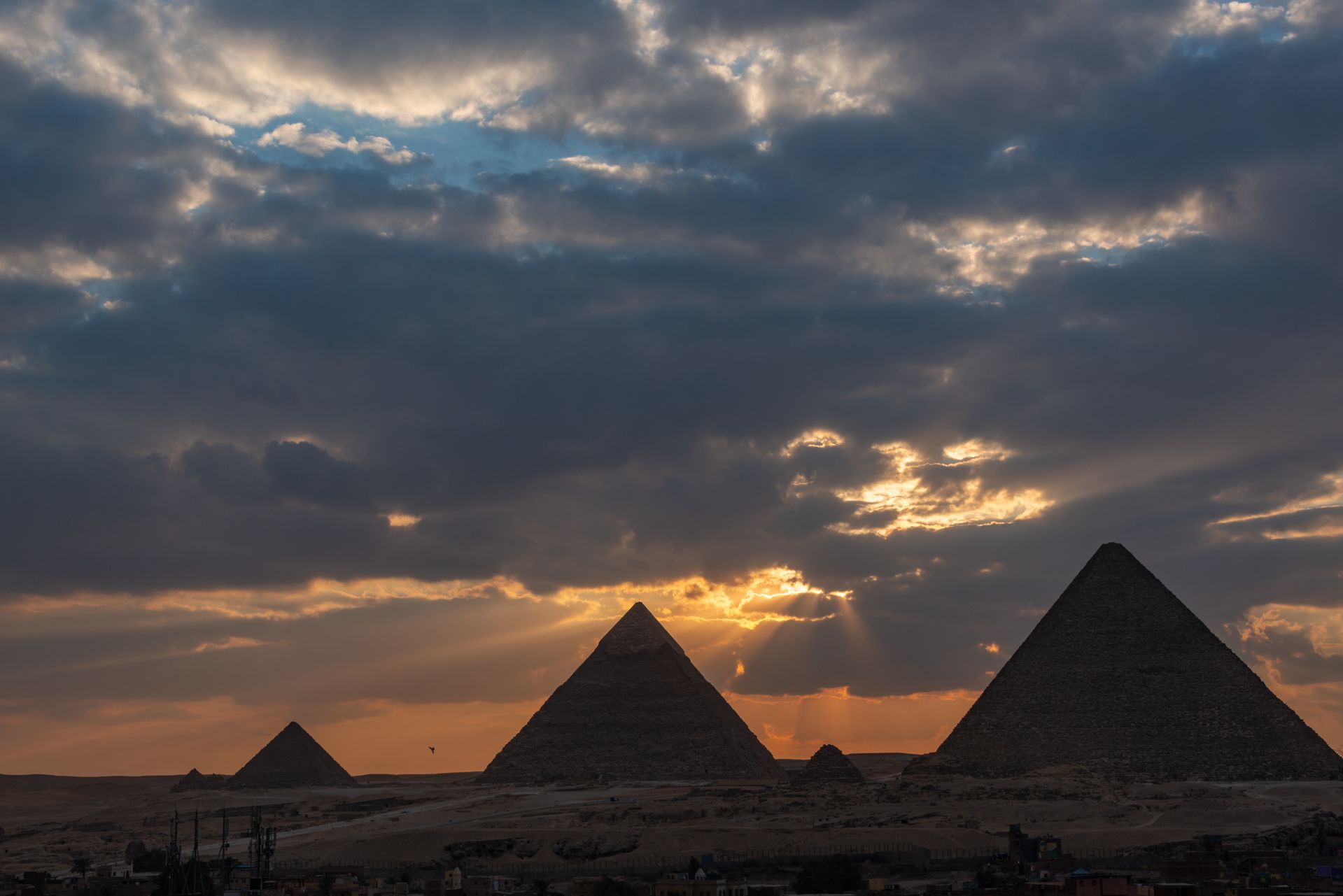
For a century the story of ancient Egypt was told in one overcrowded pink building on Tahrir Square, where masterpieces sat in wooden cabinets under handwritten labels and half the collection was in the basement. That era ended in November 2025. Egypt has spent the last few years redistributing its antiquities across four sites, and the result is a country whose greatest museum is now a twenty minute walk from the monuments it explains. Anyone who last visited Cairo before the move will find the map redrawn. Here is what sits where, and how to build the days around it.
The Grand Egyptian Museum
The building alone justifies the trip. It stands on the edge of the Giza plateau with its plan set on lines running to the pyramids of Khufu and Menkaure two kilometres away, so the monuments appear through the glass wall as you climb the grand staircase, which is lined with royal statuary arranged so that the kings rise with you. A colossus of Ramesses II, some 3,200 years old, holds the atrium.
The reason the world waited two decades is upstairs. More than five thousand objects from Tutankhamun’s tomb are displayed together for the first time since Howard Carter emptied it in the 1920s, which means the burial can finally be read as the assemblage it was rather than as a scattering of famous highlights. Twelve further galleries run from prehistory to the Greco-Roman period, organised by theme as much as by dynasty, and a separate hall holds the cedar boat buried beside the Great Pyramid for Khufu’s journey through the afterlife.
Two practical points. Give it four hours minimum, six if you intend to read anything. And book ahead: the museum shifted to online timed entry through its official portal not long after opening, and the slots at the start of the day are the ones worth having, since the galleries fill from mid morning. Anyone who has queued at the Uffizi already knows the lesson.
The plateau itself
The pyramids are what everyone comes for, and the ticketing catches people out. General admission to the site, around 700 Egyptian pounds for foreign visitors at the time of writing, gets you onto the plateau and up to the Sphinx. It does not include going inside anything. The Great Pyramid, the pyramids of Khafre and Menkaure, the painted tomb of Meresankh III and the workers’ cemetery are all separately ticketed, and the Ministry of Tourism and Antiquities publishes the current structure on its site.
Be honest with yourself about the interiors. The climb into the Great Pyramid is a hot, bent-double scramble up a wooden ramp to a bare granite chamber, and the reward is the fact of being there rather than anything to see. The tomb of Meresankh III, granddaughter of Khufu, is the better ticket by some distance: painted reliefs of the queen and her mother, statues cut from the rock, colour that has held for four and a half thousand years. Go early. The plateau opens at seven in winter, the light is better, and the coach fleets have not yet arrived.
What stayed in Tahrir
The Egyptian Museum did not close, and treating it as an emptied building would be a mistake. Tutankhamun and the royal mummies have gone, but the Narmer Palette is still here, the object on which the unification of Upper and Lower Egypt was first recorded, and so are the burials of Yuya and Thuya, the treasures of Tanis, and the seated statue of Khafre with the falcon at his neck. It also keeps something the new museums cannot replicate: the atmosphere of a nineteenth century collection, dim and crowded and slightly overwhelming, which is how Europeans first encountered these objects. Hours are short, roughly nine to four with the ticket window closing an hour before, so it works best as a morning.
The mummies in Fustat
In April 2021 twenty-two royal mummies were carried across Cairo in a televised procession to the National Museum of Egyptian Civilization in Fustat, an evening of chariots, horses and a gun salute that half the world watched. They now lie in a dimmed gallery built to evoke the Valley of the Kings, where they were found. Seqenenre Taa II is here with the axe wounds that killed him still visible in his skull, along with Hatshepsut, Thutmose III and Ramesses II. It is the quietest of the four sites and the most affecting, and the upstairs galleries covering Coptic and Islamic Egypt are the best short course in the country’s later history anywhere in Cairo.
Saqqara and Dahshur, where the story starts
Giza is the climax, not the beginning. Half an hour south at Saqqara stands the step pyramid of Djoser, built around 2650 BC by the architect Imhotep and the first monumental stone building anywhere. Its stacked terraces are the moment a mastaba tomb became a pyramid. Further south at Dahshur, Sneferu built the Bent Pyramid, whose angle changes halfway up because the engineers realised mid-construction that it was too steep, then got it right with the Red Pyramid next door. Khufu, his son, inherited the finished technique. Both sites see a fraction of Giza’s crowds, and at Dahshur you can often walk into a pyramid alone.
Doing it properly
Four days covers Cairo without rushing: the museum and the plateau on separate days, Tahrir and Fustat paired, Saqqara and Dahshur together. October to April is the season, since summer on an unshaded plateau is punishing.
The one decision that changes the trip more than any other is whether you hire a guide. Egypt is not a country where wandering with a guidebook works well: the sites are vast and unlabelled, the touts at Giza are relentless, and the difference between looking at a wall of hieroglyphs and reading one is a licensed Egyptologist standing beside you. Most guides here have university degrees in the subject and a state licence to prove it, which is not true of the men offering camel rides at the gate. Booking a private guide directly through a platform such as ToursByLocals, where you can read a specific guide’s reviews and message them before committing rather than joining an anonymous coach group, gives you someone accountable for your day and a pace you control. Ask for someone who specialises in the Old Kingdom if the pyramids are the point, and tell them plainly if you would rather spend three hours at Saqqara than tick off six sites. The good ones prefer it that way.