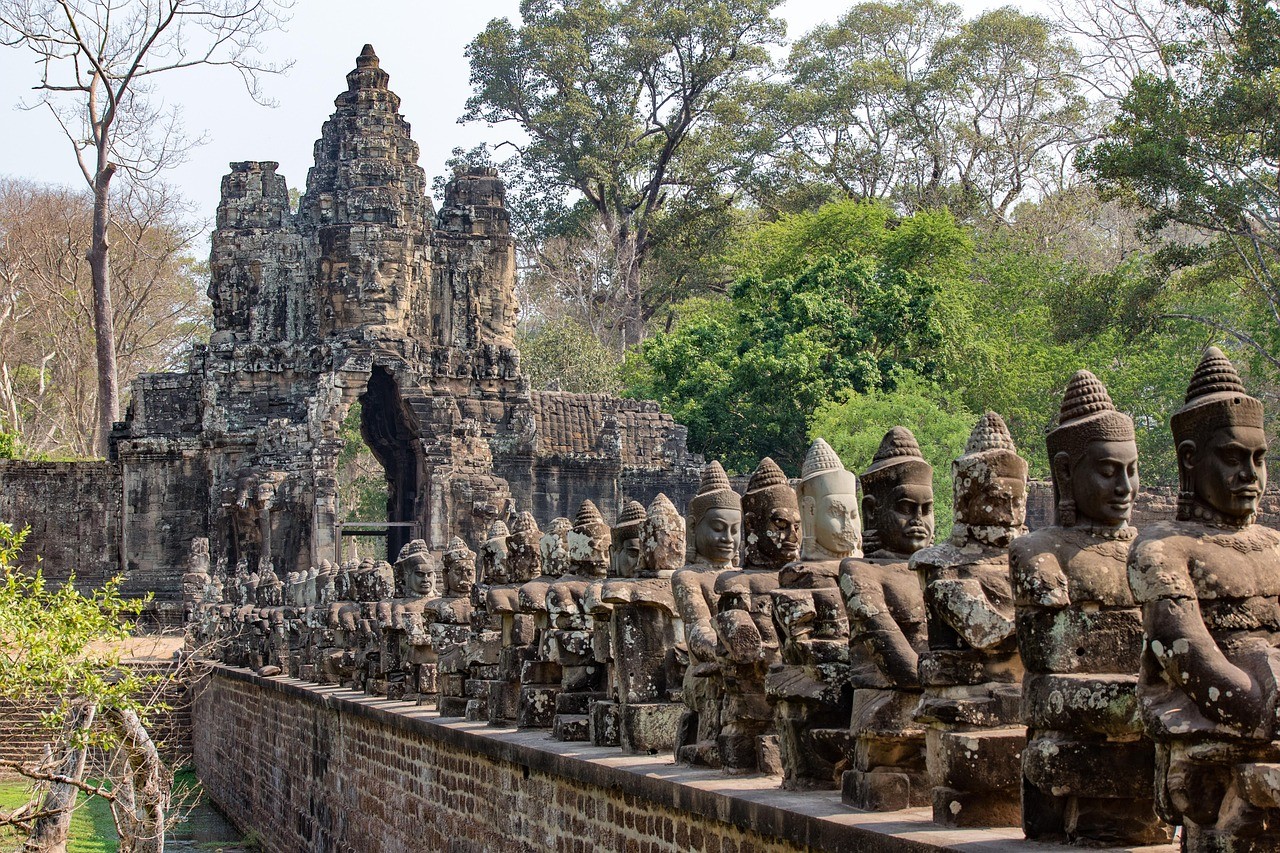
The first thing to understand about Angkor is that it is not a temple. It is the remains of a city that covered something in the order of four hundred square kilometres and, at its height around the twelfth century, may have been the largest preindustrial settlement on earth. What held it together was water: a system of reservoirs, canals and moats on a scale that let a rice economy support a capital of that size, and whose eventual failure had as much to do with the city’s decline as any invading army.
That scale is why most visitors get Angkor wrong. They arrive for one day, queue in the dark for the photograph everyone has already seen, and leave having walked through maybe a fiftieth of the site. Here is how to structure it instead.
What you are actually looking at
Angkor Wat was built by Suryavarman II in the first half of the twelfth century as a Hindu temple to Vishnu, and its layout is a model of the cosmos: five towers for the peaks of Mount Meru, the moat standing in for the ocean at the world’s edge. It is oriented west rather than east, which is unusual and has fed centuries of argument about whether it was always intended as a funerary monument. The bas reliefs running round the outer gallery are the finest narrative carving in Southeast Asia, nearly a kilometre of churning seas, marching armies and a vividly unpleasant hell.
Angkor Thom, the walled city to the north, belongs to Jayavarman VII, who came to the throne after a Cham invasion and rebuilt on a scale nobody has matched since. At its centre sits the Bayon, whose towers carry more than two hundred serene carved faces that turn to follow you around the upper terrace. Ta Prohm, the temple left partly in the grip of silk cotton and strangler fig roots, is his too, built for his mother.
One myth worth dropping: Angkor was never lost. French accounts of the 1860s introduced it to European readers, but Buddhist monks had lived and worshipped at Angkor Wat continuously for centuries, and Portuguese and Spanish visitors wrote about it in the 1500s.
The pass, and the people selling fake ones
Entry works on a single ticket covering the whole park, sold by Angkor Enterprise, a state operator. It costs 37 dollars for one day, 62 for three days and 72 for seven, and two dollars of every ticket goes to the Kantha Bopha children’s hospital in Siem Reap. Children under twelve enter free, though bring their passport, because staff will ask.
The three-day pass is almost always the right buy. Three separate one-day tickets cost 111 dollars, the multi-day passes let you use non-consecutive days so you can take a rest day in the middle, and the seven-day pass costs only ten dollars more than the three.
Every pass carries a photograph of the holder, taken at the counter or uploaded online, and it is checked against your face at each temple. Passes are not transferable, and one shared between two people gets confiscated. Buy from the official Angkor Enterprise site, the ticket office on Apsara Road about four kilometres from town, or the self-service kiosks in Siem Reap, and nowhere else. Angkor Enterprise has published warnings about websites impersonating its platform, and there is a long-running scam involving official-looking roadside ticket booths on the way to the temples, sometimes with a tuk-tuk driver in on it. The passes they issue are refused at the gate. Note also that Koh Ker and Phnom Kulen sit outside the pass and need separate tickets, while Beng Mealea is now included.
Which circuit, and in what order
Two loops organise the central park. The small circuit, around seventeen kilometres, takes in Angkor Wat, Angkor Thom and the Bayon, the Terrace of the Elephants, Ta Keo and Ta Prohm. If you genuinely have one day, that is the day. The grand circuit, about twenty-six kilometres, swings wider to Preah Khan, Neak Pean, Ta Som, East Mebon and Pre Rup. It is quieter, more varied and better in the afternoon.
Banteay Srei sits thirty-seven kilometres north-east and is on neither loop. Go anyway. The carving in its pink sandstone is the most accomplished at Angkor, deep and crisp where everything else has softened, and the temple is small enough to absorb in an hour.
A workable three-day shape: classics on day one, grand circuit on day two, Banteay Srei and something further out on day three. Break between about eleven and two every day, when the light is flat and the heat is worst, and come back for the late afternoon, which is when Ta Prohm empties and the stone goes gold.
The sunrise question
Thousands of people stand at the northern reflection pool every morning for the same photograph. If that image is the reason you came, go, but go knowing you will be in a dense crowd in the dark, having left your hotel at half past four. The park opens at five.
The better version is to arrive at sunrise on your second or third morning, ignore the pool, and walk into the temple itself while the crowd is still outside photographing the exterior. You will have the galleries almost to yourself for an hour. The same logic that empties the Acropolis at opening works here, except that at Angkor the crowd is concentrated in one spot you can simply walk past.
For sunset, Phnom Bakheng is the famous choice and is capped, so people queue for it. Pre Rup and Ta Keo give you the same light with a fraction of the company.
Conduct, and the work going on around you
Angkor is a working religious site, not a ruin field. Shoulders and knees must be covered to enter, and the upper level of Angkor Wat, the Bakan, is open only to visitors aged twelve and over. The APSARA National Authority, which has run the park since a royal decree created it in 1995, publishes a visitor code of conduct and a temple map in four languages, and both are worth ten minutes before you go.
Look for the scaffolding while you walk, because the international restoration effort here is one of the great collaborative projects in archaeology. Indian teams have worked on Ta Prohm, a Japanese project on the Bayon, the World Monuments Fund on Phnom Bakheng, a Korean team on the Elephant Terrace. Angkor was on the list of World Heritage in Danger until 2004, and the reason it came off is visible in every propped lintel.
Get a guide, and get a good one
Angkor is barely labelled. Without someone to read it, the bas reliefs are decorative rather than legible, and the difference between a Hindu temple later adapted for Buddhist worship and one built Buddhist from the start is invisible. Cambodian guides are licensed and many have studied the site seriously, which is not true of everyone offering their services at the gate.
Book a private guide rather than joining a coach group, because the whole value here is pace: stopping for forty minutes at one gallery, skipping a temple that does not interest you, going back to Ta Prohm at four instead of at ten with everyone else. A platform such as ToursByLocals lets you read a specific guide’s reviews and message them before booking, which matters more than the brochure copy. Tell them plainly what you want. A guide who hears that you would rather spend two hours at Banteay Srei than tick off six temples will usually be delighted.
When to go
November to February is the dry season and the reason this article is timed as it is: warm rather than punishing, clear light, and the busiest months of the year, so book guides and hotels ahead. March to May is genuinely brutal heat. From June to October the green season fills the moats and the reservoirs, turns the whole park a colour you do not see in the postcards, and empties it of visitors. If you can tolerate an afternoon downpour, that is the connoisseur’s season.